Padel Court Construction Cost: 2026 Investment and Profitability Guide
From floor selection to glass panels, lighting to permit processes; examine every item of padel court construction cost with 2026 current figures. ROI calculation, profitability analysis and facility management software guide.
What Will You Learn in This Guide?
- 2026 current padel court construction cost items (floor, glass, steel, lighting)
- Price difference and advantage comparison between open (outdoor) and indoor padel courts
- Standard padel court dimensions and FIP technical requirements
- Artificial turf, acrylic and tartan surface options: which is more advantageous?
- Is padel investment profitable? Revenue-expense balance and ROI calculation
- Business model selection: hourly rental, membership and lesson revenue optimization
- Permits and legal processes: what is required where?
- Facility management software: how does it increase return on investment?
Table of Contents
- 01Padel Investment Opportunity in Turkey
- 02Padel Court Construction Cost: All Items
- 03Open vs Indoor Court: Cost and Profitability Comparison
- 04Standard Padel Court Dimensions and Technical Specifications
- 05Floor Selection: Artificial Turf, Acrylic and Tartan
- 06ROI Calculation: When Does the Investment Pay Back?
- 07Business Model and Revenue Optimization
- 08Permits and Legal Processes
- 09Investor Experiences
- 10Padel Facility Management Software
Padel Investment Opportunity in Turkey: Why Now?
Padel is one of the fastest growing sports in the world. This sport, which has a decades-long history in Spain and Argentina, has gained serious momentum in Turkey in the 2020s. According to current market data, the number of padel courts in Turkey increases significantly every year; however, demand continues to run far ahead of supply. This gap is the key factor that differentiates padel court investment from competing sports investments.
Annual growth rate of Turkey padel market
Investment return period for well-positioned facilities
Can be played from age 8 to 70, social sport
Key Point for Investor
Padel is a sport with a high repeat rate thanks to the trio of low operating costs + fast learning curve + social structure. Once customers start, they don't want to stop; this keeps the facility's occupancy rate noticeably above competitors.
Padel Court Construction Cost 2026: All Items and Current Figures
Most people researching padel court construction cost look for a single price figure. But the real picture is much more detailed: total cost consists of eight main interconnected items, and optimizing each item both protects the budget and reduces long-term operating expenses.
| Cost Item | Open Court (₺) | Indoor Court (₺) | Note |
|---|---|---|---|
| Ground preparation & drainage | 40,000 – 80,000 | 60,000 – 120,000 | Varies by existing ground conditions |
| Steel construction | 80,000 – 140,000 | 150,000 – 350,000 | Galvanized, static calculation per wind load |
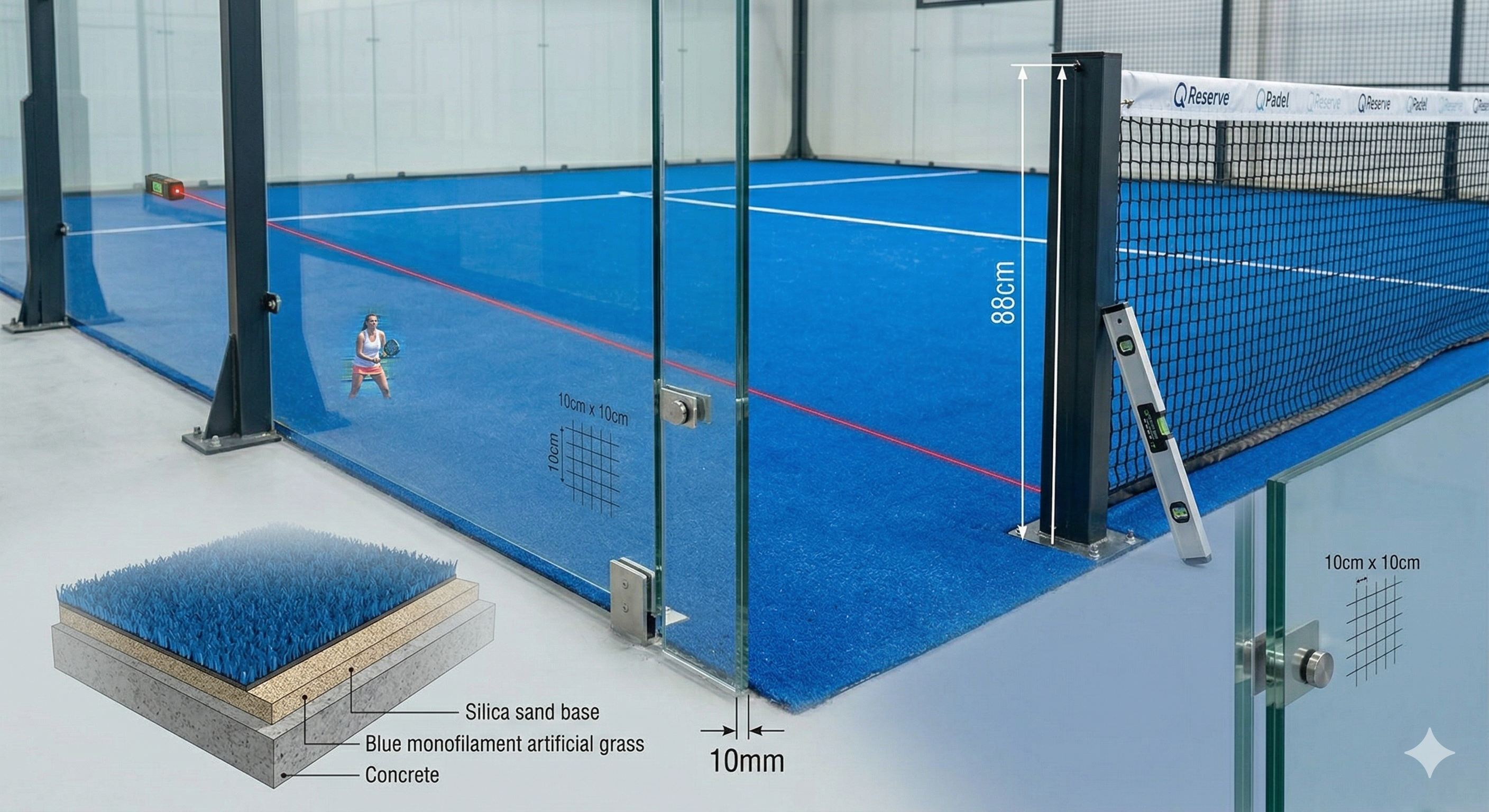
| Tempered glass panels | 100,000 – 180,000 | 100,000 – 180,000 | 10-12mm thickness, FIP approved |
| Artificial turf flooring | 60,000 – 100,000 | 60,000 – 100,000 | FIP approved, DTEX and pile height critical |
| LED lighting system | 40,000 – 80,000 | 50,000 – 90,000 | 200 lux standard; motion sensor savings |
| Net and accessories | 15,000 – 25,000 | 15,000 – 25,000 | Net, benches, scoreboard |
| Building system (for indoor) | — | 500,000 – 1,500,000 | Steel sandwich panel or canopy system |
| Transport and assembly labor | 30,000 – 60,000 | 50,000 – 100,000 | Distance and regional labor rate |
| Permit and project cost | 10,000 – 30,000 | 20,000 – 60,000 | Municipality, architect, static calculation |
| TOTAL (average) | 375,000 – 695,000 | 1,005,000 – 2,525,000 | Excl. VAT, 2026 Q1 reference prices |
Important Note: The prices in the table reflect Turkey conditions for the Q1 period of 2026. Exchange rate movements (steel, glass and artificial turf are imported materials) can affect the total cost by 15-25%. At least 3 separate supplier quotes are recommended for final pricing.
Open (Outdoor) vs Indoor Padel Court: Cost and Profitability Comparison
The most critical decision in padel investment is whether to set up an open or indoor facility. This decision determines not only the initial cost but also the occupancy rate, seasonal risk, and long-term profitability. Both models have distinct advantages and disadvantages.
Open (Outdoor) Court
Advantages
- Low startup cost (500,000 – 700,000₺)
- Fast installation (4-8 weeks)
- Minimal construction permit
- Low monthly operating expenses
- Panoramic view; superior spectator experience
Disadvantages
- Rain and winter occupancy loss
- Seasonal revenue fluctuation
- Sun/wind conditions affect game
- Higher annual floor maintenance need
Indoor Court
Advantages
- High occupancy rate year-round
- Revenue independent of bad weather
- Additional revenue areas (café, changing rooms)
- Corporate rental and tournament opportunities
- Can charge higher hourly rates
Disadvantages
- High startup cost (1,000,000₺+)
- Building permit and long approval process
- High electricity and HVAC costs
- 6-9 months construction and preparation time
QReserve Recommendation: Hybrid Approach
In Turkey's major cities (Istanbul, Ankara, Izmir), starting with 1-2 open courts for the first investment and adding an indoor system after occupancy and demand are confirmed is the most common successful model. This approach minimizes risk while offering the opportunity to test demand and build a local customer base.
Standard Padel Court Dimensions and FIP Technical Requirements
Padel court dimensions are determined by FIP (International Padel Federation) with international standards. Complying with these dimensions is critically important not only for game rules but also for insurance, licensing and future rights to host tournaments.
Padel Court Dimensions According to FIP Standards
Critical Warning: Don't Compromise on FIP Standards
Courts that deviate from FIP dimensions have difficulty being insured, cannot obtain national federation licenses, and cannot host tournaments in the future. Some seemingly cheaper offers don't meet these standards — remember to ask about FIP certification when getting quotes.
Padel Court Floor Selection: Artificial Turf, Acrylic and Tartan Comparison
Padel court floor specifications directly determine both the quality of the game and long-term maintenance costs. The wrong floor choice both reduces player satisfaction and generates renewal costs within a few years. Each of the three main options — artificial turf, acrylic and tartan — has different advantages.
| Feature | Artificial Turf | Acrylic Surface | Tartan Surface |
|---|---|---|---|
| Installation cost | Medium | Low | Medium-High |
| Lifespan | 12-15 years | 8-10 years | 15-20 years |
| Player comfort | High (shock absorbing) | Medium | Medium-High |
| Game speed | Medium (slow bounce) | Fast | Medium |
| Maintenance difficulty | Medium (sand renewal) | Low | Low |
| FIP approval | ✓ Yes | ✓ Yes | ✓ Yes |
| Post-rain drying | Fast | Very fast | Medium |
| Injury risk | Low | Medium | Low |
| Preferred facility type | Clubs, professional | Recreational, budget-focused | Multi-purpose sports facility |
The most common preference in the industry is FIP approved artificial turf. Artificial turf, the most balanced choice in terms of both player satisfaction and injury risk, should be selected with DTEX value (thread linear density) and pile height (10-12 mm) criteria. Low quality artificial turf deteriorates in 3-4 years, generating additional renewal costs.
ROI Calculation: When Does the Padel Court Investment Pay Back?
The answer to the question of whether padel court is profitable is not a single number; it is a spreadsheet dependent on location, occupancy rate and business model variables. Below we make an ROI calculation through realistic scenarios.
Scenario: 2-Court Open Padel Facility — Monthly Revenue/Expense Model
Monthly Revenue Items
Monthly Expense Items
Total investment for 2 open courts ~750,000₺ → 12-37 month ROI period. In low-rent locations and high occupancy rates, ROI drops to 12-15 months.
Business Model and Revenue Optimization: Hourly Rental is Not the Only Option
Most padel investors design their revenue model solely as hourly court rental. However, the revenue structure of successful padel facilities is much more diverse. Diversifying revenue both reduces seasonal risk and increases customer loyalty.
Hourly Court Rental
Main revenue source. Peak hours (18:00-22:00) can be priced 40-60% higher. Occupancy is optimized with dynamic pricing software.
Membership System
Fixed monthly revenue, guarantees base earnings even at low occupancy. Value is increased with benefits such as unlimited or credit lesson plans and tournament access.
Lessons and Clinic Programs
Beginner courses, advanced technical clinics and group lessons. The most valuable segment in terms of both revenue and customer loyalty.
Corporate and Event Rentals
Company team days, tournament organizations, private event rentals. Block rental offers higher yield than per-hour pricing.
Padel Court Permits and Legal Processes
The area where many padel investors are caught most unprepared is permits and legal processes. Projects started without the right information can experience 3-6 month delays and face additional costs. Here is the step-by-step process:
Land Use and Zoning Status Query
1-2 weeksFirst query the zoning status of the parcel from the relevant municipality. Eligibility for 'sports facility' or 'recreation area' use is mandatory. If this step is skipped, the entire process can be reset.
Architectural Project and Structural Calculation
3-6 weeksAn architectural project, structural calculation and soil survey document prepared by a licensed architect and civil engineer is required. FIP dimensions compliance is documented at this stage.
Municipal Construction Permit Application
4-12 weeksA 'sports facility construction permit' for open courts and a full 'building permit' for indoor courts is required. Varies from municipality to municipality; the process may be longer in metropolitan areas.
Business Operating License
2-4 weeksAfter construction is complete, a 'workplace opening and operating license' must be obtained. Noise permits, fire precautions and health conditions are inspected.
Sports Federation Registration (Optional but Recommended)
2-6 weeksRegistration with Turkey Padel Federation or Turkish Tennis Federation is required for hosting official tournaments and training licensed players. Also valuable for institutional reputation and enrollment marketing.
Real Experiences from Padel Investors
Experiences of entrepreneurs who opened padel facilities in different cities of Turkey:
"I started with 2 open courts, reached 72% occupancy in the first 6 months. Managing this many people without software would have been impossible — reservation conflicts, payment tracking, memberships... Without QReserve I would have had to hire 1 more person, which would have seriously delayed the ROI."
"We wanted to set up an indoor facility but the permit process took 5 months longer than expected. Instead of wasting this time, we first opened with 1 open court and built a customer base. When we added the indoor part, we had a ready audience — this strategy really saved us."
"When I made my ROI calculation, I only calculated with hourly rental revenue, I was wrong. Lesson programs and corporate rentals make up 35% of my total revenue. Planning these items from the start and managing them with software significantly raised my revenue ceiling."
Padel Facility Management Software: The Overlooked Multiplier of Investment
The item that most investors don't include in the budget when calculating padel court construction costs, but which most affects ROI, is facility management software. Facilities operating without a system lose 20-30% of their potential revenue due to reservation conflicts, payment losses and staff inefficiency.
QReserve Padel: What Facility Management Software Gains You
Online Reservation System
24/7 self-service reservation; reduces staffing needs, increases customer satisfaction
Dynamic Pricing
Automatic higher pricing for peak hours, maximum revenue through occupancy optimization
Membership Management and CRM
Membership plans, loyalty program, customer history and repeat booking incentives
Automatic Payment Tracking
WhatsApp and email reminder automation for hourly rental and membership fees
Court-Based Occupancy Report
Which time slot is most popular, which court is less preferred — data-driven decisions
Lesson and Coach Management
Lesson schedules, coach assignment and lesson-based revenue tracking on one platform
SEO Profile Page
Rank high in searches like 'padel court Istanbul', acquire new customers
Mobile-Compatible Panel
PWA accessible from any device for operators and players — no app download required
14-day free trial • No credit card required • Opening day support included
Frequently Asked Questions
How much does padel court construction cost in 2026?
As of Q1 2026, an open padel court can be set up in Turkey for an average of 500,000 – 800,000₺, and an indoor court between 1,000,000 – 2,500,000₺. These figures can vary by 15-25% depending on the exchange rate. Total cost covers ground preparation, steel construction, glass panels, artificial turf flooring, LED lighting, net-accessories, transport-installation and permit expenses.
What are the standard padel court dimensions?
According to FIP standards, standard padel court dimensions are: length 20 meters, width 10 meters (total 200 m²). Back walls are 3m high tempered glass, side walls are 3-4m high. A minimum area of 12m × 22m = 264 m² is required for court installation; ceiling height must be at least 6 meters in an indoor facility.
Is padel court investment profitable?
Yes, padel investment can pay back within 12-24 months with the right location and business model. There is a monthly revenue potential of 80,000-120,000₺ for a 2-open-court facility. Low operating costs, high repeat rate and appeal to a wide age group are factors that make padel attractive among sports investments. However, location, competition analysis and business model are the most critical variables that determine ROI.
How to choose padel court flooring?
FIP approved artificial turf is the most common and recommended option. Pile height of 10-12mm, FIP certified material should be used. Acrylic surface is more economical but player comfort is lower; tartan offers high durability. Low quality artificial turf requires renewal in 3-4 years; choosing quality flooring at the start is more economical in the long run.
How much space is needed for a padel court?
A minimum usable area of 12m × 22m = 264 m² is required for a single padel court. It is healthier to think of 300-350 m² including corridors, technical areas and spectator areas. 500-600 m² is recommended for a 2-court facility, and 1,000-1,200 m² for a 4-court padel center. Ceiling height must be min. 6 meters in an indoor system.
Is a municipal permit required for a padel court?
Yes, municipal construction and operating permits are mandatory for commercial padel courts. A ground change permit is required for open courts, and a building permit for indoor courts. The process varies from 1-6 months by region. Parallel planning of permit processes; running construction and permits simultaneously shortens the total project timeline.
Why is padel facility management software necessary?
Padel facilities without a system experience 20-30% reservation and revenue loss. A management software like QReserve provides online reservations, membership management, payment automation, occupancy analysis and SEO profile page on a single platform. In exchange for a monthly software cost of 2,000₺, it typically provides 10-20x more revenue protection. Having the system ready on opening day directly affects the customer first impression.
What are the padel court operating costs?
Monthly operating expenses: rent 20,000-40,000₺, staff 25,000-40,000₺, electricity 5,000-10,000₺, maintenance 2,000-4,000₺, marketing 3,000-6,000₺, software-operational 2,000-3,000₺. Total monthly expenses range from 57,000-103,000₺ for a 2-court facility. Using reservation software can reduce staffing needs by 0.5-1 employee.
Conclusion: Where Should You Start with Padel Court Investment?
Padel is a sport and investment area that continues to grow in Turkey. With proper planning, padel court construction cost can turn into an investment that pays back in 12-24 months. A successful padel facility has three main pillars: correct location analysis, FIP-compliant installation and digital facility management from day one.
The absence of any of these three pillars negatively affects the other two. The vast majority of unsuccessful examples in the sector are attributed to either the wrong location or systemless operation. The data and analyses in this guide are designed to minimize these risks.
Manage Your Padel Facility Professionally from Opening Day
Set up online reservations, membership management and automatic payment tracking on a single platform with QReserve Padel. Try free for 14 days.
QReserve
Professional reservation and facility management system for padel facilities, tennis clubs and sports complexes. The choice of over 200 sports facilities in Turkey. We are with you in the success of your investment.