Tennis Coach Guide: How to Assign the Right Starting Level to Players
An incorrect starting score undermines both a player's motivation and open match quality. Conduct a fair and fast assessment with five weighted skill categories based on NTRP standards — so players leave the court with balanced match-ups from their very first game.
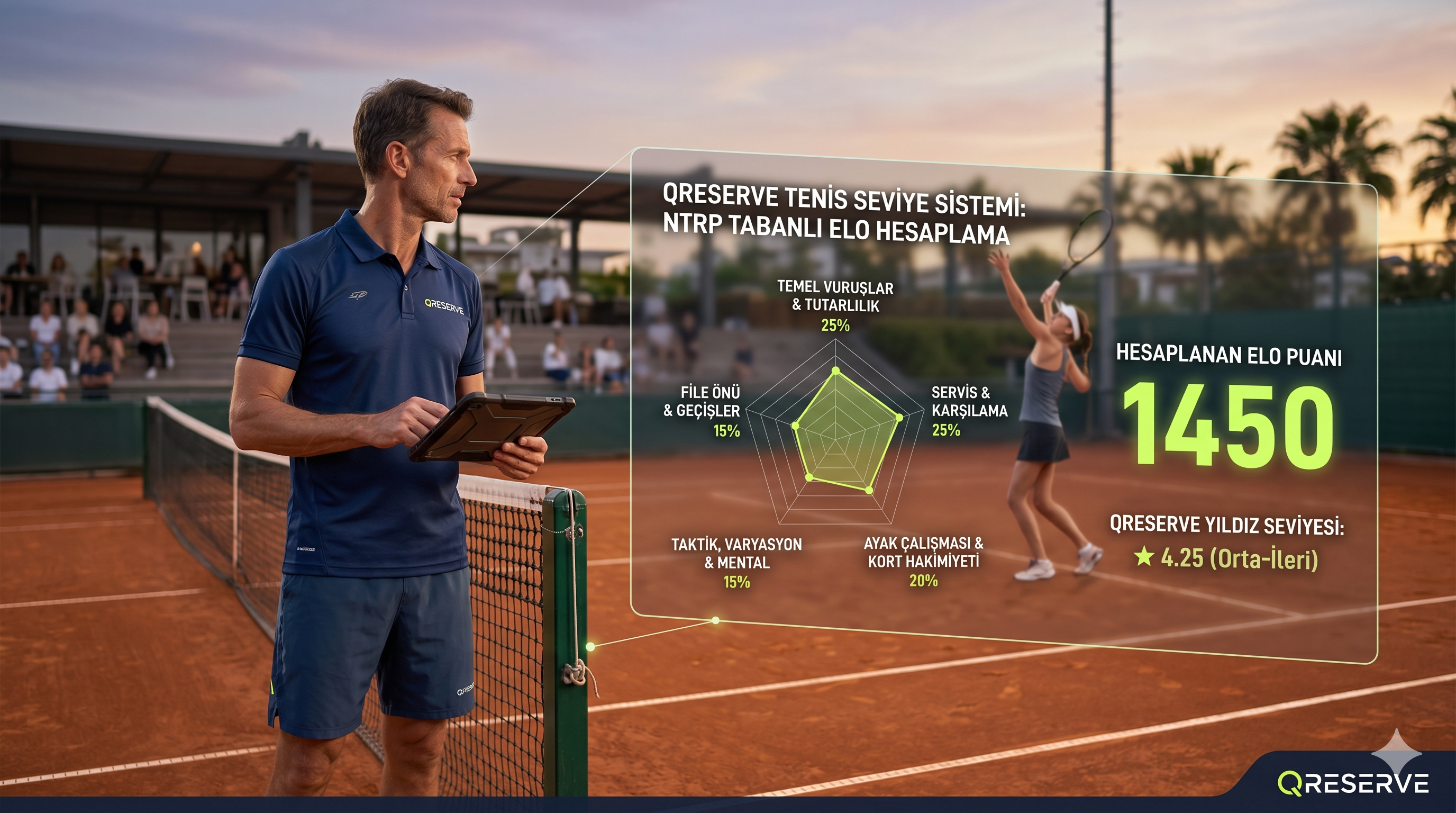
Why an NTRP-Based Assessment?
NTRP (National Tennis Rating Program) is a standard level classification framework developed by the USTA and widely accepted worldwide. QReserve's assessment model is based on this international reference, making the coach's scores consistent and universal. Adopting this standard at tennis courts and facilities in Turkey also enables correct match-ups even when players transfer between cities.
Table of Contents
How an Incorrect Starting Score Affects Open Matches
In open matches, the Elo-based matching system pairs players with similar scores. For these balanced matches to work, every player must enter the system with a score reflecting their actual level. Although the rapid adjustment algorithm for a player's first 10 matches partially compensates for an incorrect starting point, match quality during this period drops significantly.
- Strong player matched with much weaker opponents
- Weak opponents lose motivation and leave the system
- Strong player loses trust in the system
- May take 10+ matches to reach actual level
- Player faces opponents above their actual level
- Consistent losses damage confidence and motivation
- New player may abandon the platform
- Downward correction process negatively impacts experience
The most effective way to prevent both scenarios is a systematic assessment grounded in the coach's observation and a standard framework. NTRP is the internationally accepted reference point that provides this framework.
5 Core Skill Categories and Their Weights
QReserve's tennis scoring model evaluates five skill categories with different weights, based on the NTRP reference framework. The weights reflect each category's actual determinism in open match performance.
| Skill | Weight |
|---|---|
| Basic Strokes & Rally Consistency | 25% |
| Serve & Return | 25% |
| Footwork & Fitness | 20% |
| Tactics, Variation & Mental | 15% |
| Net Play & Approach Shots | 15% |
Basic strokes and serve/return categories are considered the most decisive factors with equal weight (25% each); these two categories directly influence the vast majority of points in tennis. Footwork forms the second group at 20%, while tactics and net play are positioned as supporting categories at 15% each.
Step-by-Step Assessment Process
The following structured session flow allows you to conduct a reliable NTRP assessment in 15-20 minutes and onboard the player with the correct score.
Have the player do free rally. Observe footwork rhythm, racket grip, and first ball contact. Don't score yet; a general impression for the coach is sufficient. Most coaches intuitively identify the NTRP band at this stage.
Run target zone rallies for forehand and backhand. Evaluate both angle and depth. Then do a first and second serve series; second serve reliability is especially critical. Smash ease and return positioning should also be tested in this section.
Feed angled balls to all four corners; observe balance and coverage speed. Then invite to the net: assess approach shot quality, volley stability, and smash. If feet stop under pressure, note the lower NTRP band.
Play a short match of 5-6 games with the player. Note decision-making processes at critical moments, whether there is technical breakdown under score pressure, and tactical variation. Then enter all your notes into the tool below and save to the system.
Tennis Coach Assessment & Scoring Tool
After completing the session, enter the five skill scores you observed into the sliders below. The tool instantly calculates the NTRP-referenced weighted average and shows the player's starting Elo score and QReserve star level.
Tenis Antrenörü Değerlendirme Paneli
NTRP standartlarına göre oyuncunun performansını 1.0 ile 7.0 arasında puanlayın.
* The calculation result can be directly transferred to the starting Elo value in the player's QReserve profile.
NTRP / QReserve Levels Reference Table
Calibrate the result from the calculation tool against this table. Check whether the QReserve star level from the tool matches the profile in the table; if there is a large discrepancy, re-evaluate your observation notes.
| QReserve Level | NTRP | Player Profile | Elo |
|---|---|---|---|
| 1.0–1.5 | 1.0 | Complete Beginner | 800–900 |
| 2.0–2.5 | 2.0–2.5 | Beginner | 900–1100 |
| 3.0–3.5 | 3.0–3.5 | Lower-Intermediate | 1100–1300 |
| 4.0–4.5 | 4.0–4.5 | Intermediate | 1300–1500 |
| 5.0–5.5 | 5.0–5.5 | Upper-Intermediate | 1500–1700 |
| 6.0–6.5 | 6.0 | Advanced / Semi-Pro | 1700–1900 |
| 7.0 | 7.0 | Professional / Elite | 1900–2000 |
Coach Tips: Ways to Validate Your Assessment
Don't overlook the backhand: even if a player has improved their forehand with practice, the backhand reveals the true level.
Second serve is critical: if the first serve is strong but the second serve is very short/slow, the NTRP band drops.
Note behavior in critical games. Technical breakdown or calmness under pressure? This is the most reliable indicator of the tactics/mental score.
Review the Elo after 5 matches from the starting session. If there is a large deviation, update the coach calibration note.
Frequently Asked Questions
How is a player's level determined in tennis?
The coach scores the player 1.0-7.0 across five NTRP-referenced skills in a 15-20 minute assessment session. The Elo value (800-2000) calculated by weighted average is applied to the player's profile, and open match pairing begins from this score.
What is the difference between NTRP and the QReserve Elo system?
NTRP is a classification system using fixed categories. QReserve Elo is a continuous scale from 800-2000 that updates dynamically based on match results. NTRP is the coach's assessment reference, Elo is the open-match pairing engine; the two systems complement each other.
How long should a tennis level assessment session last?
15-20 minutes is sufficient for an experienced coach: 5 min warm-up, 7 min basic stroke and serve drills, 5 min footwork and net play, 3 min short game simulation.
How does an incorrect starting score affect tennis open matches?
A score that's too low matches a strong player with weaker opponents, damaging both sides' experience. A score that's too high causes a new player to consistently lose at a higher level and disengage from the system. A correct starting score prevents both scenarios from the outset.
Related Articles
All Blog PostsDynamic Elo Rating System for Padel & Tennis
Find opponents at your level. Enjoy open matches with a 1.0-7.0 dynamic rating system.
Read articleTennisTennis Court Management System
A practical management approach that simplifies daily court operations.
Read articlePadelPadel Coach Level Assessment Guide
The systematic way to assign fair starting scores to padel players with 5 core skills.
Read articleLeagueWhat Is the Defi League?
Discover league formats that improve player retention and community growth.
Read articleLet Fair Matches Begin at Your Tennis Facility
With QReserve's Elo-based open match system, your players face opponents at their own level in every match. Register your facility today.