Padel Coach Guide: How to Assign the Right Starting Level to Players
An incorrect starting score directly affects a player's experience and the facility's open match quality. Conduct a fair and fast level assessment with a weighted Elo system measuring 5 core skills — so players leave the court with the right match-ups from their very first game.
Why Is the Starting Score So Critical?
The open match system is growing rapidly at padel courts across Turkey. But for the system to work fairly, every player must start with a score that reflects their real level. Otherwise, strong players are matched with weak opponents and vice versa — neither side enjoys the match. As a coach, the key to setting this equation right is in your hands.
Table of Contents
How an Incorrect Starting Score Affects Open Matches
In open matches, the Elo-based matching system pairs players with similar scores. For these balanced matches, every player must enter the system with a score close to their actual level. Although a rapid adjustment algorithm kicks in during a player's first 10 matches, the system cannot fully correct an incorrect starting point — the quality of pairings during this period suffers.
- Strong player matched with weak opponents
- Beaten players lose motivation
- Strong player loses trust in the system
- Takes 10+ matches to reach actual level
- Player faces opponents above their level
- Constant losses damage self-confidence
- New player may disengage from the system
- Score correction process negatively impacts experience
The only way to prevent both scenarios is a systematic assessment based on the coach's observation. Using a standard framework instead of subjective impressions ensures consistency and provides a reference point in case of disputes.
5 Core Skill Categories and Their Weights
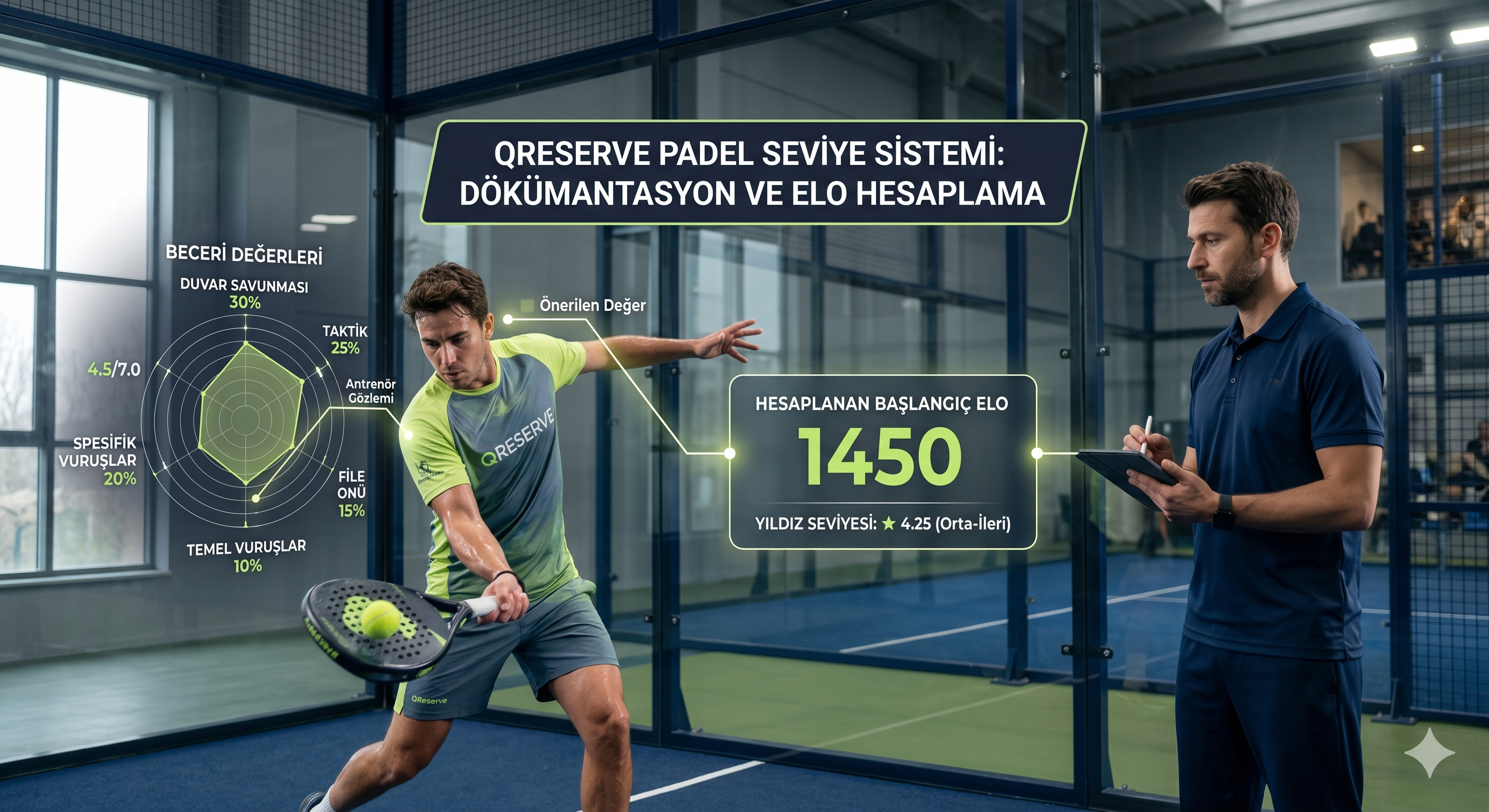
QReserve's scoring model evaluates five padel-specific skill categories with different weights. The weights reflect each category's real determinism in open matches: wall defense plays a much more critical role than basic strokes in padel.
| Skill | Weight |
|---|---|
| Basic Strokes | 10% |
| Net Play & Smash | 15% |
| Bandeja, Vibora & Lob | 20% |
| Tactics & Positioning | 25% |
| Wall Defense | 30% |
The 30% weight for wall defense may seem striking; but this is precisely what distinguishes padel from tennis. Being able to return to the ball using the back wall is the decisive skill in long rallies. This is why the model assigns this skill the highest weight.
Step-by-Step Assessment Process
The following structured session flow allows you to conduct a reliable assessment in 15-20 minutes while also familiarizing the player with the system.
Have the player do free rally. Observe their court movement, how they hit the racket, and where they direct the ball. Don't score yet; just get a general impression. Most coaches intuitively sense the player's approximate level at this stage.
Run target zone drills for forehand and backhand. Then have the player do smash and volley series from a net-close position. Take 1-7 notes for each skill. 2-3 repetitions are sufficient for inconsistent results; use the average value.
Play balls coming from the back and side walls. Observe bandeja and vibora attempts; if they don't know these shots at all, the 1.0-2.0 range is appropriate. Wall defense drills are the most critical stage; pay attention to the player positioning close to the wall and returning the ball into play.
Take the player into an independent match scenario. Observe tactical decisions, partner coordination, and behavior under pressure. After the match, enter your notes into the calculation tool below and save to the system.
Coach Assessment & Scoring Tool
After completing the session, enter the five skill scores you observed into the sliders below. The tool instantly calculates the weighted average and shows the player's starting Elo score and corresponding QReserve star level.
Antrenör Değerlendirme & Puanlama Paneli
Oyuncunun korttaki performansını 1.0 ile 7.0 arasında puanlayın.
* The calculation result can be directly transferred to the starting Elo value in the player's QReserve profile.
Padel Levels Reference Table
Interpret the result from the calculation tool by referring to the table below. The table summarizes what a player at each level band demonstrates on court and provides the coach with a calibration reference point.
| Level | Player Profile | Elo |
|---|---|---|
| 1.0–1.5 | Complete Beginner | 800–900 |
| 2.0–2.5 | Beginner | 900–1100 |
| 3.0–3.5 | Lower-Intermediate | 1100–1300 |
| 4.0–4.5 | Intermediate | 1300–1500 |
| 5.0–5.5 | Upper-Intermediate | 1500–1700 |
| 6.0–6.5 | Advanced | 1700–1900 |
| 7.0 | Professional / Elite | 1900–2000 |
Coach Tips: Ways to Validate Your Assessment
Strong players don't show technical breakdown even under stress. Observe performance under pressure.
Ask the player about their own level. Their intuition is usually close to reality and reduces the risk of disputes.
Review the score again after 5 matches from the starting session. If there are large deviations, recalibrate.
Observing doubles play provides more tactical information than singles. Plan a doubles session if possible.
Frequently Asked Questions
How is the starting level determined in padel?
The coach scores the player 1.0-7.0 across five core skills in a 15-20 minute assessment session. The Elo value calculated by weighted average (between 800-2000) is applied to the player's profile.
How long should a padel level assessment session last?
15-20 minutes is sufficient for an experienced coach: 5 min warm-up, 5 min basic stroke and net tests, 7 min specialty shot and wall drills, 3 min short game simulation.
How does the QReserve Elo system differ from Playtomic?
In QReserve's system, the starting score isn't just based on match outcomes — it's determined by five weighted skill scores from a coach assessment. This means the player starts open matches with an Elo much closer to their true level.
How does incorrect level assignment affect open matches?
A score that's too low matches a strong player with weaker opponents, ruining their experience. A score that's too high causes new players to struggle above their level and disengage from the system. A correct starting score prevents both scenarios.
Related Articles
All Blog PostsDynamic Elo Rating System for Padel & Tennis
Find opponents at your level. Enjoy open matches with a 1.0-7.0 dynamic rating system.
Read articlePadelPadel Court Booking System
How to digitize padel bookings and increase occupancy in your facility.
Read articleLeagueWhat Is the Defi League?
Discover league formats that improve player retention and community growth.
Read articleTennisTennis Court Management System
A practical management approach that simplifies daily court operations.
Read articleLet Fair Matches Begin at Your Facility
With QReserve's Elo-based open match system, your players face opponents at their own level in every match. Register your facility today.